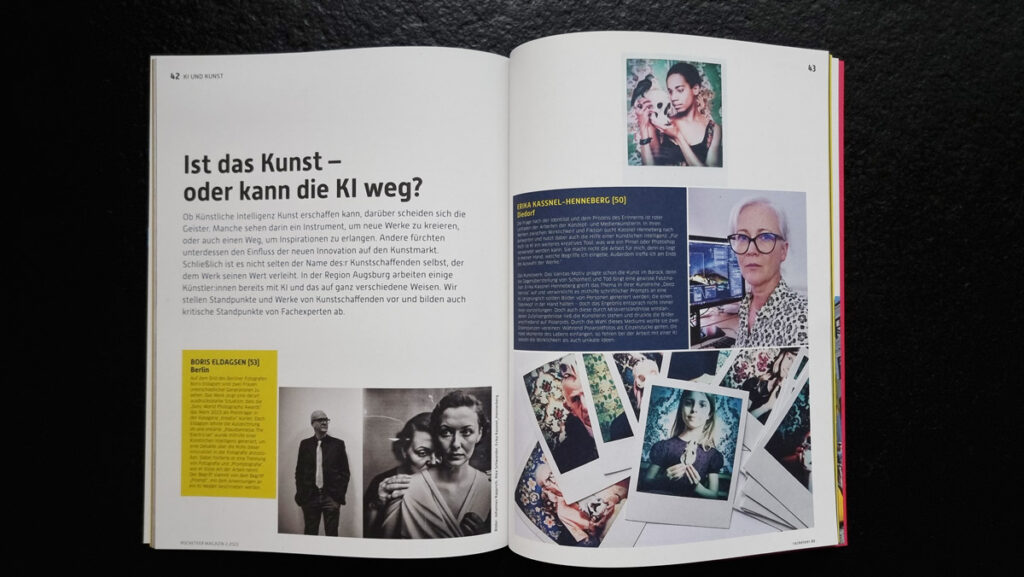
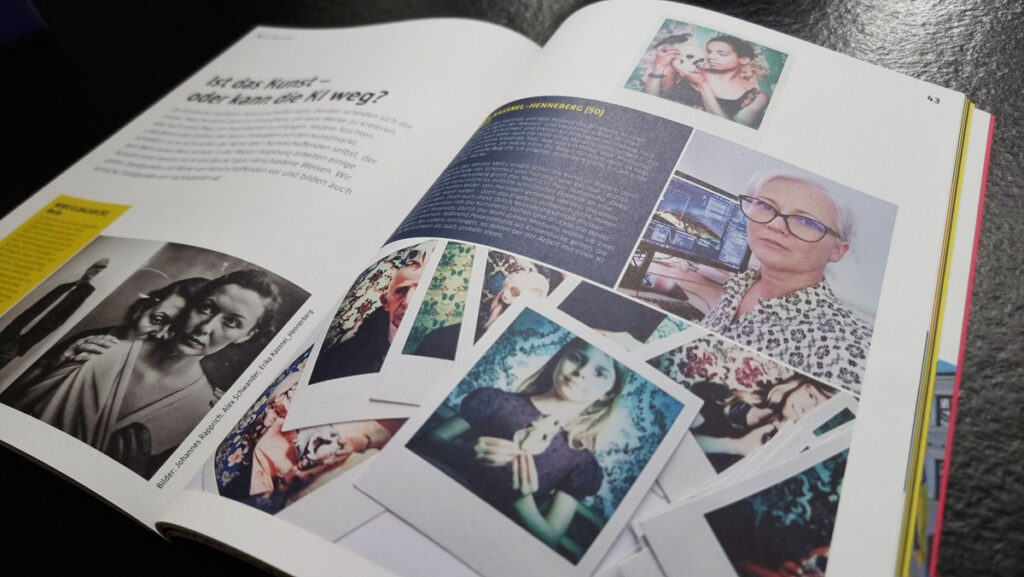
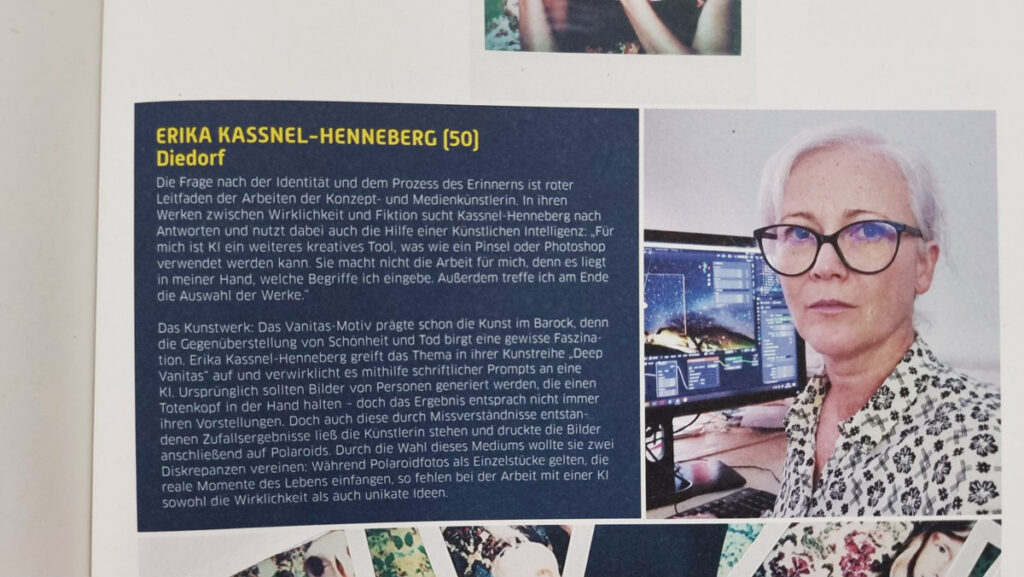
Tagesspiegel, May 19 2026. This interview on artificial intelligence and creativity in art was conducted in preparation for the article “Enrichment or Threat? How AI Models Are Changing Art” by Elena Winter. Click here to read the article (This interview appears in a heavily shortened form in the article).
AI is deeply impacting artistic, moral, and political structures
Many people (especially those who work in creative fields) are currently concerned about the rapid development of AI. You, on the other hand, are actively working with it. Why? And to what extent do you feel that AI might present an even greater challenge to you as an artist?
Indeed, we are faced with fundamental, largely unresolved questions: Who is the creator? Who bears responsibility? And how do we prevent misuse? At present, there is a lack of clear guidelines—and this is precisely what makes the situation so explosive. In addition, AI is deeply impacting artistic, moral, and political structures. At the same time, we are witnessing a global race for technological supremacy, while European policymakers often react rather than actively shape the future. As a result, in many areas, we still do not fully understand the consequences of our own actions.
That is precisely why I believe it is crucial to actively engage with AI. After all, it is not a passing fad, but a structural turning point. Those who shy away from it risk ceding interpretive authority to others—and, with it, the ability to shape our future. For this reason, I work with AI deliberately: to understand its mechanisms, explore its possibilities, and reveal its limitations. Ultimately, my goal is to develop a self-determined approach, rather than simply conforming to technological developments.
I also share this knowledge in my workshops. In particular, when it comes to AI image generators, there is a persistent misconception that all you have to do is press a button and automatically receive relevant art. However, that is simply not true. Instead, good results emerge from precise prompting, experience, iterative processes, and deliberate artistic decisions. Therefore, working effectively with AI requires a certain level of technical understanding—and for many, this is where the real challenge begins.
Ultimately, we live in a world that is increasingly shaped by technology. Whenever knowledge is lacking, mystification can quickly take hold. For this reason, a basic understanding of technology will become a core cultural skill in the future—not as a replacement for traditional abilities, but rather as a complementary skill on par with reading, writing, and arithmetic.
Serendipitous Detours and Chance Encounters
Many ideas arise from serendipitous detours, chance encounters, and so on. AI, on the other hand, draws from the black box of the algorithm. How do you reconcile these two? Would you attribute creative potential to AI?
I consider the idea that AI is creative to be a projection. After all, AI is not a thinking or willing entity—it is a machine. What it produces is based on statistical processes, rather than on creative intent.
The actual image ideas still come from humans. However, what is new is the act of translation: we have to express our ideas in language with such precision that the machine can process them. In this sense, AI is not a counterpart, but rather a tool—albeit a very complex one.
Things become particularly interesting when this tool does not work the way we expect it to. For example, misunderstandings in the prompt or surprising results can lead to unexpected outcomes. It is precisely these disruptions that create the moments we like to describe as “coincidences” or “happy accidents.” Nevertheless, even these are not creative acts on the part of the machine, but rather effects of the way it functions.
At the same time, we tend to attribute human characteristics to AI. However, this can obscure what really matters: creativity does not arise from the algorithm itself, but from human selection, evaluation, and contextualization. Therefore, those who attribute creativity to AI are oversimplifying the process—and, at the same time, underestimating their own responsibility within the artistic process.
Distorting and Manipulative
Are there also moments in your creative work when you find AI to be restrictive, distorting, manipulative, or similar? What are some examples of these?
AI is not neutral. Its results are always shaped by the data it was trained on—and by the perspectives of those who develop it.
I’ve experienced this very concretely in my own work. For my 2022 video piece “Homunculus,” I used AI-generated portraits from a website that generated a random face every time the page loaded, without any user influence. My goal was to depict diversity: in gender, age, and cultural background. Instead, I kept getting very similar faces: strikingly often female, middle-aged, light-skinned. At some point, I started keeping tally sheets—and my impression was confirmed. This is no coincidence, but a structural problem.
In moments like these, AI is not only limiting, but actively distorts the reality it purports to depict.
Added to this is an aesthetic tendency toward uniformity. Many AI-generated images fall within the visual norm—they are technically impressive, but often also surprisingly bland and interchangeable. As an artist, one must consciously work against this uniformity.
It becomes particularly manipulative when these images are circulated. Deepfakes are no longer a marginal phenomenon, but a powerful tool—for disinformation, political staging, and targeted deception. What is new is not so much the manipulation itself as its quality: images and videos are so convincing today that trust in visual media as a whole is eroding.
At the same time, countermeasures are already emerging. The first tools capable of detecting deepfakes are now available. The crucial question will be whether we become faster at uncovering deception than new forms of deception emerge.
Creativity in Future
In what ways do you think our understanding of creativity will change in the future as a result of AI?
Artificial intelligence is fundamentally transforming art — not so much as a style, but rather as a tool and a space for thought. In doing so, it lowers technical barriers and enables more people to work visually and bring their ideas to life. At the same time, however, it raises important questions about authorship, originality, and artistic responsibility.
Nevertheless, many people overestimate AI because they underestimate the physical and experience-based dimensions of human creativity. Although AI can accelerate, combine, and imitate, it remains functionally limited. In particular, it lacks the diversity of human intelligence: it has no physicality, no emotional or social intuition, no imagination, and no motivation. For example, grappling with materials, engaging in sensory experience, or physically realizing an idea are processes that a machine cannot fully accomplish—neither today nor in the future.
Ultimately, creativity arises from the interplay of experience, intuition, decision-making, and reflection. It is also rooted in the physical dimension of action: in working with materials and engaging with the body. Therefore, creativity does not lie within the system itself, but rather in the way we interact with and respond to the system.
At the same time, AI opens up new possibilities. It can provide inspiration, shift thought processes, and help develop ideas in directions one might not have pursued independently. When used consciously, it expands the scope of creative action rather than replacing it.
The decisive shift, therefore, lies not in machines becoming creative, but rather in humans redefining their own role: as the ones who select, evaluate, and take responsibility. Those who consciously shape this role gain freedom. Conversely, those who delegate it risk losing it.