In Entity Dreams Body, the boundaries between life and simulation are explored: A breathing skin balloon rises and falls, next to it a child’s toy whose lifelike eyes return the gaze. Human fragments, technology, and toys merge into a hybrid being – familiar and eerie at the same time.
The work negotiates the boundaries between humans and machines, between what is technically feasible and what is ethically acceptable. Prostheses and enhancements do not appear as progress, but as unsettling transformations that alienate humanity. Instead of envisioning harmonious coexistence, the installation reveals the ambivalence and unease of a possible future: Where does the synthetic begin to transform the human? And how can a balance between humanity and alienation still be conceived in a world of permanent enhancement?
The Installation
The loop extends into the physical space: ten Polaroids showing a toy—breathtakingly similar to the hybrid creature—in a child’s hands. The photographs are based on documentary material and bear the traces of a real past.
From another corner of the room, a voice drifts in, rambling about “posthumanism.” A sculpture made of pedestals rises up, with a small CRT television serving as its “head.” The screen displays the digitally reconstructed head of my son as a child. The voice and text are AI-generated.
The work combines memory and technological simulation and condenses questions about identity, reproduction, and the role of humans in the posthuman era.
At the center of Kassnel-Henneberg’s work is the question of a new humanism. It focuses on the role of humans in a digital world. She explores how artificial intelligence, algorithms, and digital systems are changing what it means to be human. At the same time, she critically asks whether humans can still act autonomously when technological processes influence or even replace decisions.
Her works open a discourse on the relationship between biological existence and technological expansion. This theme runs through her entire Time-Based Media Art portfolio. It shows how technology deeply shapes human perception and identity.
Cross-Media Practice Between Analog and Digital
Kassnel-Henneberg understands her artistic practice as a bridge connecting analog and digital worlds. Therefore, she works across multiple media, including:
Video
CGI (Computer Generated Imagery)
Artificial Intelligence
Polaroid Photography
Collage and Mixed Media
Through this combination, she creates works that exist between reality and simulation, and between documentation and construction. The audience is invited to critically reflect on their perception, which is increasingly shaped by media. At the same time, the use of analog techniques creates a compelling dialogue between past and present.
Education and Interdisciplinary Foundations
Her artistic development is based on an interdisciplinary education. First, she studied restoration at the Bern University of the Arts. There, she learned technical skills and developed a deep understanding of materiality, history, and cultural heritage. She then studied Interactive Media at Augsburg University of Applied Sciences.
This combination of conservation knowledge and digital media expertise forms the foundation of her Time-Based Media Art portfolio. It allows her to connect traditional and modern techniques effectively.
Exhibitions, Festivals, and International Recognition
Kassnel-Henneberg’s works have been presented nationally and internationally. A highlight is her solo exhibition “Uncanny Valley” at the Neue Galerie in the Höhmannhaus of the Augsburg Municipal Art Collections. The exhibition addressed the uncanny feeling that arises when artificial systems increasingly resemble humans.
Additionally, she has participated several times in the FILE – Electronic Language International Festival in São Paulo. This festival is one of the world’s leading platforms for digital and time-based media art. It underscores the international relevance of her work.
Awards and Artistic Recognition
2013: Krumbach Art Prize for the book object “Heimat ist anderswo”
2022: Augsburg District Art Prize for her overall body of work
These awards recognize not only her ongoing engagement with identity, memory, and social change. They also demonstrate the significance of her Time-Based Media Art portfolio in contemporary art.
Teaching, Jury Work, and Media Culture
In addition to her artistic practice, Kassnel-Henneberg works as a lecturer. She teaches at Augsburg University of Applied Sciences and various private art academies. Moreover, she actively participates in juries and supports emerging positions in media art.
Her teaching and curatorial work complements her artistic practice. It also strengthens the discourse around time-based media art in Germany.
Conclusion: Time-Based Media Art as Societal Reflection
Erika Kassnel-Henneberg’s work exemplifies contemporary art that combines aesthetic innovation with social relevance. Her Time-Based Media Art portfolio invites reflection on humanism, technology, and identity in a connected world. At the same time, it shows how art can provide guidance and critical reflection in a complex digital reality. https://eri-kassnel.de/sichtbar-verknuepft-frei/https://gedok-muc.de/
In a room enclosed by concrete walls, the camera circles a golden apple. Beyond the walls, there is no exterior space, no sky—only a formless blackness. Two faceless avatars appear, directing their actions toward the apple without ever reaching it. Its reflective surface reveals a second environment: a sealed-off, abandoned place with caged windows.
The scene is structured as a closed loop. Approach, violence, and repetition intertwine without reaching a conclusion. The apple functions as a fixed point—a center that both focuses and blocks the sequences.
In the end, the room remains empty: surrounded by concrete, covered with traces of action, counting, and marking.
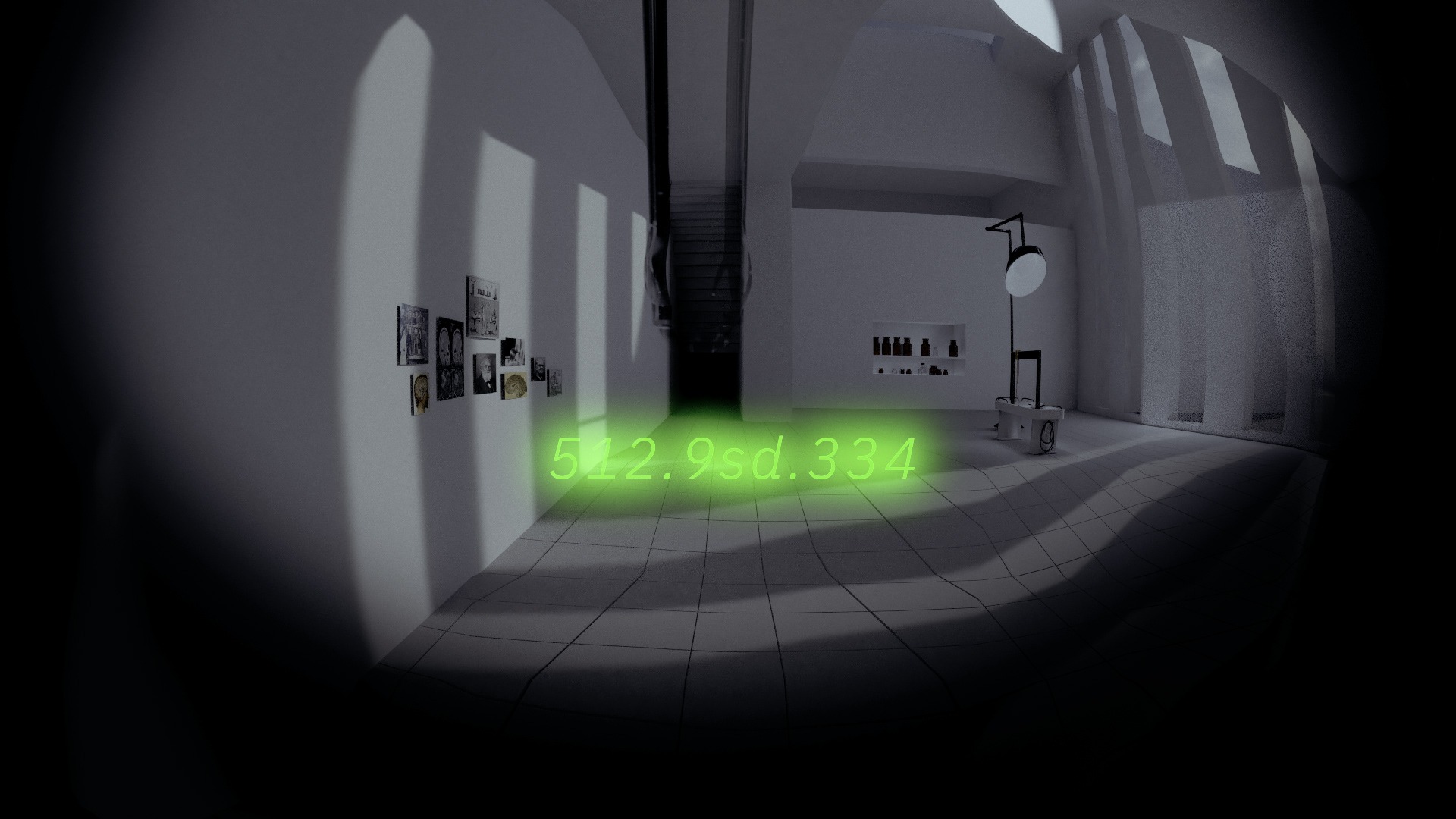
This video shows a corridor-like space with no doors or windows. A pendulum with a light bulb swings like a clockwork between the sides of the room, creating a mechanical rhythm of light and darkness. In this alternation, wall surfaces become visible, covered with fragments of memory: a floral wallpaper, a devotional image, a stuffed deer head, and cryptic formulas that denote “eternity” and “remembering” as variable states. At first, these elements seem familiar and biographically rooted.
With the repetition of the pendulum’s swing, this legibility shifts. The scene loses its intimacy and tips into a condensed, claustrophobic structure. The room appears less as a place than as a system of repetition and feedback, in which personal and historical traces are no longer separable.
The space thus becomes a repository without hierarchy, in which memory is not archived but continuously reconstructed. What appears as biographical material dissolves into an abstract logic of recurrence.
The Installation
This logic continues in the transition to the physical installation. Objects from the video reappear in real space, dissolving the boundary between virtual and physical space. A devotional image of the Christ Child feeding doves and ceramic animal skulls reflect the motifs shown. Individual objects reappear on Polaroids on the wall, including the stuffed deer head. Through this repeated translation between media, things circulate between reality, image, and meaning. Documentation, staging, and ideology become indistinguishable. The space appears both real and constructed – as a symbol of a present in which historical relics, political narratives, and media repetitions create an experience of permanent recurrence.
Extension into physical space: a framed art print, 2 ceramic animal skull sculptures, 11 polaroids.
Spatial installation, 76th Great Swabian Art Exhibition, Hall 1 – Room for Art in the Glaspalast, Augsburg, 2024
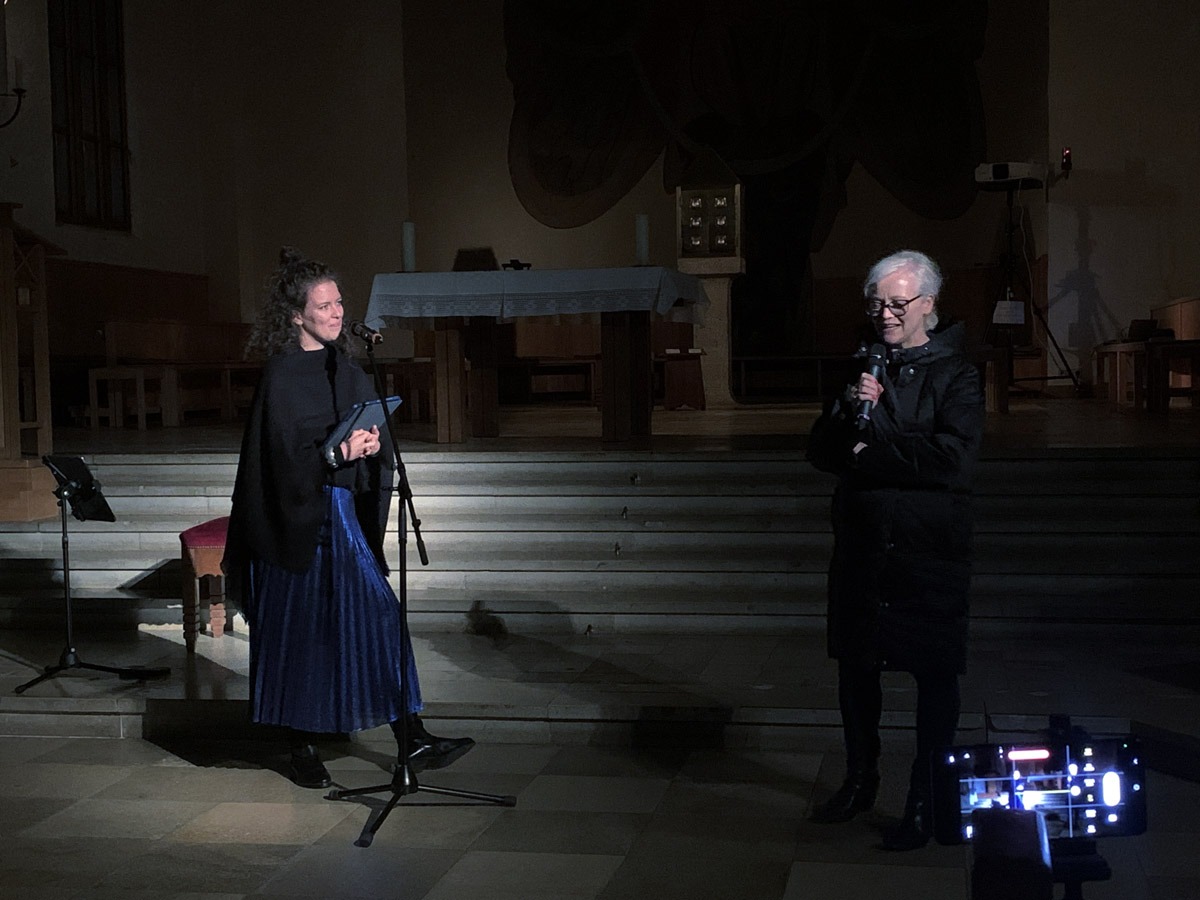
Vernissage on November 3 at 7 p.m. in St. Konrad, Bärenstr. 22, 86156 Augsburg, Germany.
Finissage on December 3.
The apple was and is in many cultures of high symbolic power: Be it as a symbol for eternal youth, eternal life, for love, fertility, paradise and fall of man. In this videoinstallation we circle around a golden apple. We recognize familiar places in the Bärenkeller (a district of Augsburg) in the background and on its reflecting surface. Like foreign bodies, two-dimensional portraits of various people float in it. Who are these people? The holy family? Our neighbors? They never existed, but are outputs of an artificial intelligence. Is this paradise on earth?
Video installation with sound, 6:07 min, AI-generated, cgi, animation,
mp4 file, 16:9 aspect ratio,
unique + 1AP,
Donated to St. Konrad Church in Augsburg-Bärenkeller.
The apple was and is highly symbolic in many cultures: be it as a symbol of eternal youth, eternal life, love, fertility, paradise and the fall of mankind.
In this installation, a golden apple floats in the air like a fixed star. Familiar places are reflected on its shiny surface (in the Bärenkeller district of Augsburg). How are people doing there and in the world?
In contrast, the two-dimensional portraits in this landscape appear strange. Who are these people? The Holy Family? Our neighbours? They never existed, but are the outputs of an artificial intelligence. We live in a time of upheaval. New technologies give us the feeling that we are increasingly losing control over truth and lies, over good and evil. Is this paradise on earth?
The apple hides a secret inside, because there is a small star made up of 5 seeds. It reminds us that our actions determine whether we come a little closer to “paradise on earth”.
The Installation
The site-specific video installation refers to the real space: church, district, city… by showing it as a digital mirror image, which in turn is reflected by the shiny surface of the golden apple. A kind of visual recursion in which reality and fiction, analog and digital merge.
Suzanne is lured into a seductive virtual dream – guided by flashing buttons and a calming voice assistant promising relief from insomnia. Unbeknownst to her, she is part of a behavioral experiment designed to manipulate her actions through algorithmic control.
The film rejects traditional narrative in favor of a fragmented, immersive loop that mirrors the disorienting logic of digital platforms – addictive, cyclical, and subtly coercive.
Social networks now shape a global economy in which attention is the most valuable resource. What appears to be free access conceals a deeper cost: constant surveillance and behavioral conditioning by tech corporations using Attention Engineering – a system that combines persuasive design, gamification, and AI, grounded in psychology.
Rabbit Hole 4.0 explores the loss of personal agency in a world where algorithms anticipate needs before we are aware of them. It reflects on the illusion of choice, the commodification of behavior, and the quiet erosion of self-determination in an era of total digital recall.
At its core, the film poses a simple but urgent question: in a world shaped by invisible influences, do we still have control over ourselves?